Choosing a High Quality Kitchen Flat Steel Pull Out Basket in 2026 requires more than checking its appearance. A polished finish can hide weak welds, thin steel, or unstable runners. The basket should move smoothly, remain level, and support everyday loads without scraping the cabinet sides. Look closely at the corners. Clean welds usually indicate better production control.
According to kitchen-storage consultant Daniel Mercer, “A reliable pull-out basket should feel quiet, balanced, and predictable after hundreds of uses.” This practical view matters because kitchen hardware faces repeated opening, moisture, heat, and accidental overloading. Measure the cabinet opening carefully, including the frame, hinges, and internal obstructions. A few millimeters can decide whether installation feels effortless or frustrating.
Choose steel with a durable, corrosion-resistant coating. Check whether the sliding rails use full-extension movement and quality bearings. Soft-closing hardware is useful, but it should not compensate for poor alignment. The basket’s height also matters. Tall bottles may need deeper clearance, while shallow shelves can improve visibility for spices and utensils.
Real kitchens are rarely perfect. Cabinet floors may be uneven. Screws may meet dense panels. These details deserve attention before purchase. Some product descriptions remain vague, which is a warning sign. Request load information, installation dimensions, warranty terms, and replacement-part support. A beautiful basket is not automatically a dependable one. The better choice balances structure, movement, cleaning convenience, and long-term service.
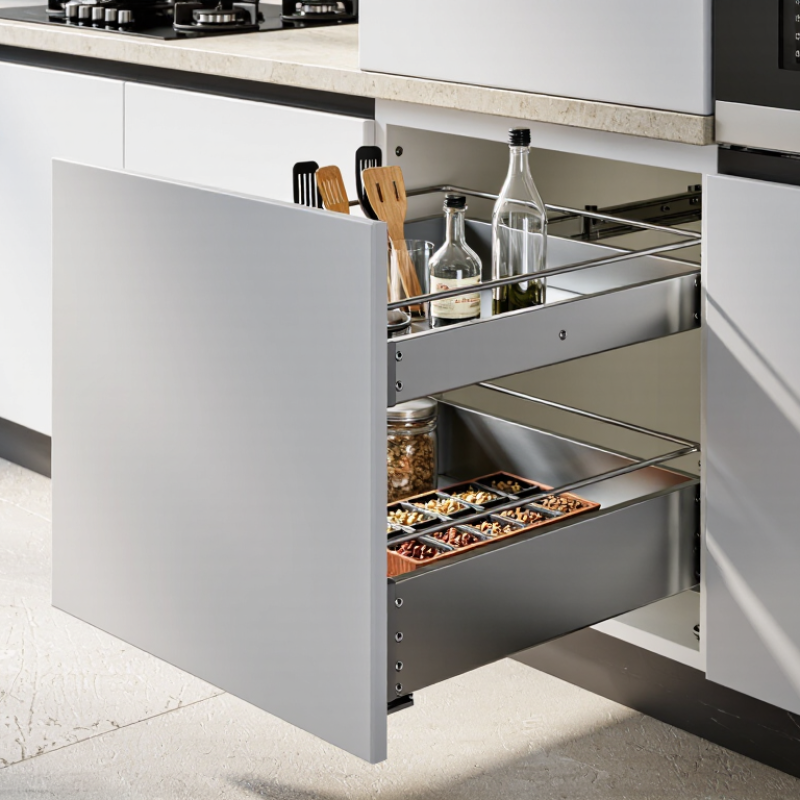
A flat steel pull-out basket is a sliding storage unit fitted inside a cabinet. Its shallow steel frame holds pans, bottles, towels, or packaged food. Telescopic runners let the basket move forward, exposing items hidden at the back.
Unlike a deep drawer, its open sides improve visibility and airflow. This matters in narrow cabinets, where poor access often causes unused space. The 2024 Houzz U.S. Kitchen Trends Study reported that 76% of renovating homeowners upgraded pantry storage. That figure reflects a practical need: people want storage that reduces reaching, stacking, and forgotten supplies.
High-quality construction depends on more than shiny metal. Check the steel thickness, weld consistency, runner rating, and surface finish. A basket can look strong but wobble under uneven loading. I would not trust a load figure without checking its test method. The EN 14749 safety standard provides useful guidance for domestic storage furniture, although product testing should still match the intended cabinet.
Tips: Measure the cabinet opening, internal depth, and door clearance first. Leave a few millimeters for movement. Choose corrosion-resistant coating for humid kitchens. Test the basket with real bottles, not empty hands. Soft-close runners feel refined, but alignment remains critical. Small installation errors can create noise, scraping, or early wear.

When choosing a high-quality flat steel pull out basket, start with the base metal. Stainless steel offers strong corrosion resistance, especially in humid kitchens. Look for consistent wire thickness and firm welds. Uneven joints may collect water and weaken under daily loads. I have inspected baskets where the surface looked attractive, but thin wires bent after repeated use. Appearance can mislead.
Cold-rolled steel can also perform well when protected by a durable finish. Powder coating is a practical choice because it creates an even, bonded surface without obvious runs. Check the corners, weld points, and underside carefully. These areas often reveal poor coverage first. A smooth finish feels dry and uniform. It should not flake when lightly scratched with a fingernail. That test is limited, though. Professional coating checks are more reliable.
Stainless steel should have clean polishing and no rust-colored marks around welds. Brushed finishes hide fingerprints better than mirror finishes. However, brushed lines must run consistently. PVD finishes can provide strong surface hardness, but their quality depends on proper preparation and thickness control. Ask for material specifications, coating test data, and load ratings. Do not trust vague claims such as “premium metal.” I would also inspect the basket after installation. Slight frame movement may come from the cabinet, not the basket, yet it still affects long-term performance. Small details matter.
Which materials and finishes indicate high quality?
How to read the chart: Stainless steel grades with approximately 16–20% chromium provide stronger inherent corrosion resistance than ordinary low-carbon steel. AISI 304 and 316 stainless steel commonly specify a minimum yield strength of about 205 MPa in annealed sheet condition.
Finish indicators of quality: Look for uniform welds, complete edge treatment, consistent brushed or polished surfaces, and a durable powder coating or electroplated finish with no exposed steel. For humid kitchens, bathrooms, and coastal environments, 304 is a common choice; 316 is preferable where chloride exposure is severe.
Reference basis: typical chemical and mechanical requirements published for stainless steel sheet grades in ASTM A240/A240M. Actual performance also depends on basket design, weld quality, surface preparation, coating thickness, and installation conditions.
Choosing a high-quality flat steel pull-out basket starts with exact measurements. Measure the cabinet’s internal width, depth, and clear opening, not the outside frame. Leave at least 2–3 mm of side clearance for smooth movement. A 300 mm cabinet may not provide 300 mm of usable space. Hinges, door panels, and plumbing can reduce it further.
Capacity must match real kitchen habits. The 2024 Houzz U.S. Kitchen Trends Study reported that 76% of renovating homeowners upgraded their cabinets, showing how strongly storage performance influences modern kitchens. For daily use, check the basket’s stated load rating and test it with dense items, such as canned food or glass jars. Ten kilograms feels very different from ten kilograms of towels. The weight distribution matters.
Load support deserves closer inspection. Look for welded joints with even seams, reinforced corners, and runners tested for repeated opening cycles. ISO 7170 furniture-storage testing evaluates stability, strength, and durability under defined loads; it offers a useful reference when comparing supplier specifications. Do not rely on appearance alone. A glossy finish can hide thin wire or weak mounting points. I would also pull the basket halfway out and check for sagging, side play, or scraping. This step is easy to miss. In practice, a basket rated for 20 kg may perform poorly if the cabinet base is uneven or the screws are short. Measure twice, load gradually, and question unclear test data.
2026 How to Choose High Quality Flat Steel Pull Out Baskets
A reliable pull-out basket begins with its slides. Check the rated load, extension range, and movement under weight. ISO 7170 evaluates storage furniture strength and durability, while EN 15338 addresses extension hardware performance. These standards provide useful benchmarks, not marketing decoration. The 2024 U.S. Houzz Kitchen Trends Study reported that 76% of renovating homeowners upgraded their cabinets. Storage hardware deserves equal attention. A smooth slide should open fully, resist side-to-side wobbling, and close without a metallic slap. Test it with bottles, cans, and a heavy pan. Then pull it repeatedly.
Stability depends on more than steel thickness. Look for a rigid frame, accurate welds, and mounting points that remain square. A basket that twists may scrape the cabinet after several months. I have seen attractive units fail because the rear bracket carried too little weight. That detail is easy to miss. Check the basket at half load and full rated load. Measure the gap around the moving frame. Uneven gaps often reveal poor alignment or weak installation.
Ease of use is practical, not theatrical. A good handle should feel firm with wet hands. The basket should stop gently and remain accessible from both sides. According to the 2023 U.S. Consumer Product Safety Commission injury data, falls and struck-by incidents remain common household risks, so secure movement matters. Avoid sharp cut edges and unstable loading. One weakness remains: published ratings may assume perfect installation. Real kitchens rarely provide that. Recheck screws, cabinet level, and clearance after fitting.
| Evaluation Item | Option A Standard Single-Tier |
Option B Reinforced Single-Tier |
Option C Soft-Close Single-Tier |
Option D Heavy-Duty Single-Tier |
Recommended Benchmark |
|---|---|---|---|---|---|
| Typical cabinet width | 300–450 mm | 300–600 mm | 300–600 mm | 450–900 mm | Select a frame that leaves installation clearance on both sides |
| Basket material | Powder-coated steel wire | Thicker powder-coated steel wire | Powder-coated steel wire with sealed slide assembly | Reinforced steel frame and base | Corrosion-resistant steel with a uniform, chip-free finish |
| Usable basket depth | 450 mm | 500 mm | 500 mm | 500–550 mm | Measure the cabinet’s internal depth, not its external depth |
| Rated dynamic load | 20 kg | 30 kg | 25 kg | 40 kg | Choose a rating at least 20% above the expected everyday load |
| Slide construction | Side-mounted ball-bearing slides | Full-extension ball-bearing slides | Full-extension soft-close slides | Heavy-duty full-extension slides | Full extension, smooth travel, and minimal lateral movement |
| Extension travel | Approximately 80% | Approximately 100% | Approximately 100% | Approximately 100% | Full extension is preferable for reaching items at the rear |
| Slide smoothness score | 3/5 | 4/5 | 5/5 | 4/5 | The basket should move without sticking, scraping, or sudden resistance |
| Side-to-side movement under load | Noticeable | Low | Low | Very low | Movement should remain low when the basket is fully extended and loaded |
| Frame stability score | 3/5 | 4/5 | 4/5 | 5/5 | Look for a rigid base, reinforced corners, and secure fixing points |
| Base deflection at rated load | Up to 5 mm | Up to 3 mm | Up to 3 mm | Up to 2 mm | Lower deflection generally indicates better support for heavy contents |
| Soft-close function | Not included | Not included | Included | Optional or integrated | Useful for reducing impact, noise, and accidental slamming |
| Opening effort with rated load | Moderate | Low to moderate | Low | Moderate | The handle should require steady, controlled force without jerking |
| Installation adjustability | Limited | Moderate | Moderate | High | Prefer adjustable mounting holes and clear alignment instructions |
| Cleaning and drainage | Open wire design; easy to rinse | Open wire design; easy to rinse | Open wire design; slides need protection from water | Open wire design; removable liner recommended | Avoid dirt traps and inspect drainage gaps regularly |
| Finish and corrosion resistance | Suitable for dry indoor use | Improved coating thickness | Improved coating thickness | High-durability coating | Check for complete coverage, sealed welds, and no exposed bare steel |
| Ease-of-use score | 3/5 | 4/5 | 5/5 | 4/5 | Prioritize clear access, smooth motion, comfortable grip, and quiet closing |
| Best suited for | Light pantry items and small cabinets | General kitchen storage | Frequent daily access and quiet kitchens | Bottles, cookware, and heavier provisions | Match the basket to the cabinet size, load, and access frequency |
| Overall evaluation | Acceptable | Good | Very Good | Very Good for Heavy Loads | A high-quality choice should score at least 4/5 for slides, stability, and ease of use |
Choosing a high-quality flat steel pull out basket depends on installation and maintenance details, not appearance alone. Measure the cabinet’s internal width, depth, and opening height before purchase. Leave enough clearance for smooth movement. A basket with adjustable mounting brackets can correct small alignment errors, which often occur in older cabinets. Full-extension, ball-bearing runners should move evenly under the stated load. Test them with weighted cookware, not an empty basket.
Tips: Check the runner rating, fixing screws, and cabinet side clearance. Soft-close hardware is useful, but it must be securely installed. Thin steel may look neat yet bend under repeated loads. A powder-coated or corrosion-resistant finish usually handles kitchen moisture better. Still, no coating lasts forever. Wipe spills quickly, especially near sink cabinets.
Maintenance Maintenance should remain simple. Clean the basket with a soft cloth and mild detergent, then dry every joint and runner. Avoid abrasive pads; they can damage the protective surface and expose steel. Inspect screws every few months, because vibration can loosen them gradually. If movement becomes rough, remove dust before applying a manufacturer-approved lubricant. Do not force a jammed basket. Find the obstruction first. In practice, many failures come from uneven loading rather than poor materials. Heavy pans belong near the center, while bottles need stable spacing. Even careful buyers sometimes overlook the cabinet floor’s strength. That detail deserves another check.